Properties Banner 3
Projects Overlay 2
Projects Overlay

Arctic


The Arctic deposit (“Arctic”), is a polymetallic volcanogenic massive sulphide deposit located approximately 470 kilometers northwest of the City of Fairbanks, Alaska. Arctic is at feasibility stage and current activities are focused on advancing permitting.

Key Facts
LocationAlaska, USA
Deposit Type Volcanogenic Massive Sulphide
HostArctic Sequence, Ambler Belt
AgeDevonian
Economic ElementsCopper, Zinc, Lead, Gold, Silver

We announced the results of the Arctic Feasibility Study (“FS”) on February 14, 2023 and filed the technical report titled “Arctic NI 43-101 Technical Report on Feasibility Study” on February 14, 2023.

The FS for the Arctic Project describes the potential technical and economic viability of establishing a conventional open-pit copper-zinc-lead-silver-gold mine-and-mill complex for a 10,000-tonne-per-day operation. The base case scenario utilizes long-term metal prices of $3.65/lb for copper, $1.15/lb for zinc, $1.00/lb for lead, $1,650/oz for gold and $21.00/oz for silver in its economic analysis. The FS was prepared on a 100% ownership basis and all amounts are in US dollars.

2023 Feasibility Study

  • Pre-tax Net Present Value (“NPV”)8% of $1.5 billion and an Internal Rate of Return (“IRR”) of 25.8%.
  • After-tax NPV8% of $1.1 billion and after-tax IRR of 22.8%.
  • At February 2023 spot metals prices of $4.02/lb copper, $1.39/lb zinc, $0.95/lb lead, $1,853/oz gold and $22/oz silver, the pre-tax NPV8% is $2.1 billion and IRR is 31.5%, and after-tax NPV8% is $1.6 billion and IRR is 27.8%.  
  • The 2023 FS is based on a 10,000-tonne-per-day open-pit mining rate with a conventional milling and flotation process that results in the production of separate copper, zinc and lead concentrates.
  • Based on the feasibility-level metallurgical work on the sulphide mineralization, the average recoveries are projected to be 92.1% for copper, 88.5% for zinc and 61.3% for lead, in their respective concentrates. Life-of-mine strip ratio (waste:ore) is approximately 7.3 to 1.
  • The 2023 FS forecasts an average annual payable production to be 149 million pounds of copper, 173 million pounds of zinc, 26 million pounds of lead, 32,538 ounces of gold and 2.8 million ounces of silver.
  • Total life-of-mine 13-year production is projected at 1.9 billion pounds of copper, 2.2 billion pounds of zinc, 335 million pounds of lead, 423,000 ounces of gold and 36 million ounces of silver.
  • Initial capital expenditure is $1,176.8 million and sustaining capital is $114.4 million for total estimated capital expenditures of $1,291.2 million.
  • Closure and reclamation costs are estimated at $428.4 million.
  • Estimated pre-tax and after-tax payback of initial capital are 2.9 years and 3.1 years respectively.
  • Estimated cash costs are $0.72/lb of payable copper (cash costs include on-site mining and processing costs, road tolls and maintenance, transport, royalties, and is net of by-product credits).
  • Total “all-in” cash costs (initial/sustaining capital, operating, closure costs and is net of by-product metal credits) are estimated at $1.61/lb of payable copper.
  • Mineral Resources are not Mineral Reserves and do not have demonstrated economic viability. There is no certainty that all or any part of the Mineral Resources will be converted to Mineral Reserves.
Insignia Alt
ResourceTonnageAverage GradeContained Metal Content
CuPbZnAuAgCuPbZnAuAg
Confidence Category(Mt)(%)(%)(%)(g/t)(g/t)(Mlb)(Mlb)(Mlb)(koz)(Moz)
Indicated35.72.980.794.090.5945.22,3476213,21667552
Indicated – 50% Attributable Interest17.852.980.794.090.5945.21,173.5310.51,608337.526
Inferred4.51.920.702.930.4335.618969288625
Inferred – 50% Attributable Interest2.251.920.702.930.4335.694.534.5144312.5
Insignia Alt
ClassificationTonnageAverage Grade
(Mt)Cu
(%)
Pb
(%)
Zn
(%)
Au
(g/t)
Ag
(g/t)
Probable Mineral Reserves – 50% Attributable Interest23.352.110.562.90.4231.8

Geology and Mineralization

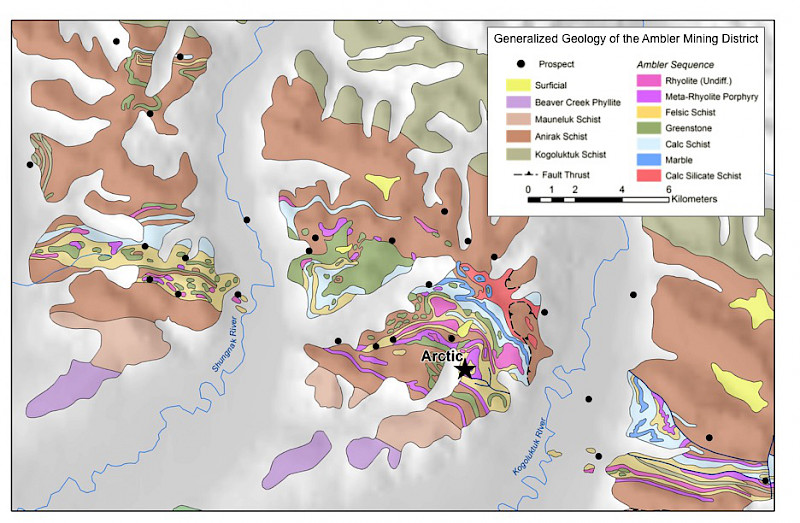
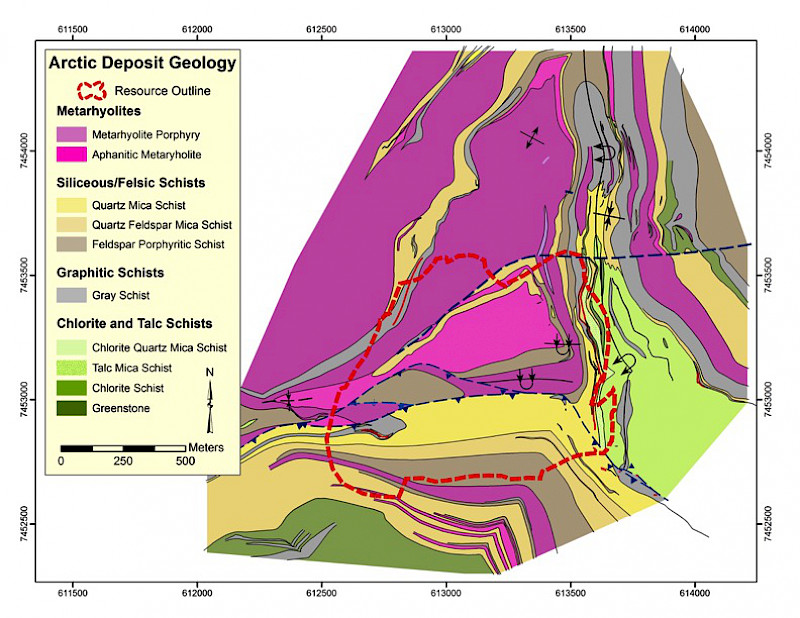
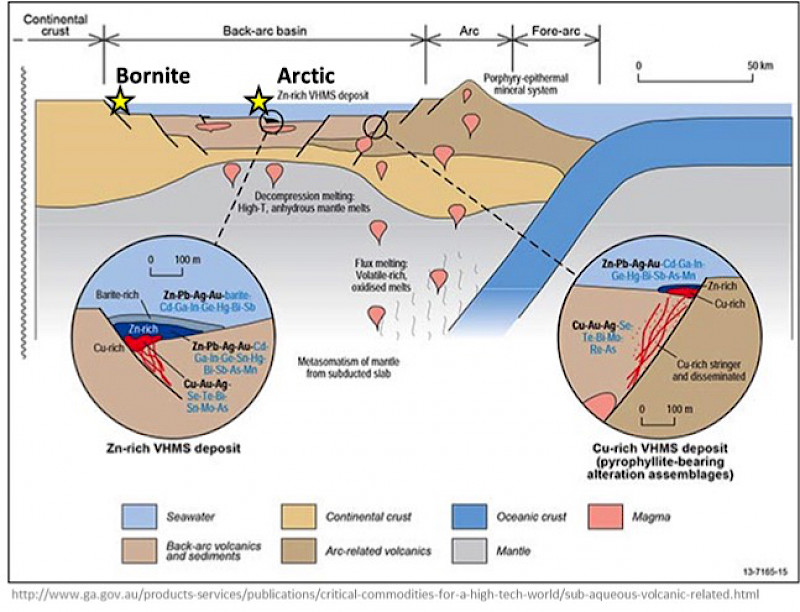
The Arctic deposit is a polymetallic volcanogenic massive sulphide (“VMS”) style deposit hosted in the Ambler Belt, a group of Middle Devonian to Early Mississippian, metamorphosed, bimodal volcanic and volcaniclastic rocks with interbedded metasediments. VMS-style mineralization occurs along the 110-kilometer strike length of the belt.

Mineralization at Arctic forms semi-massive to massive sulphide beds composed of coarse-grained sulphides consisting mainly of chalcopyrite, sphalerite, galena, tetrahedrite, arsenopyrite, pyrite and pyrrhotite within graphitic and quartz mica (+/- chlorite) schists. The sulphide beds average 4 meters in thickness but vary from less than 1 meter up to as much as 25 meters in thickness. The bulk of the mineralization is within an area of roughly 1 km2 with mineralization extending 250 meters below the surface.
Maps

Logo Pipeda
Privacy Overview

This website uses cookies so that we can provide you with the best user experience possible. Cookie information is stored in your browser and performs functions such as recognising you when you return to our website and helping our team to understand which sections of the website you find most interesting and useful.